

Loading...
Hi Poke Friends!
How are you all enjoying the new set? Despite the Darkrai dominance, I’ve been enjoying myself a lot with all of the new cards. I’d enjoy myself a lot more if I got more Ex cards in my packs, but that’s between DeNa and myself. One thing I do notice when I play though is that some cards might not be used optimally by some folks.
Today I want to focus on two cards in particular: Giant Cape and Pokémon Communication. For both cards, there’s the deckbuilding and play aspect of it – I’ll preface everything as well by saying that a lot of this is my opinion, so you’ll need to come to your own conclusions. Anyway, let’s dive in!
Giant Cape
Deckbuilding theory

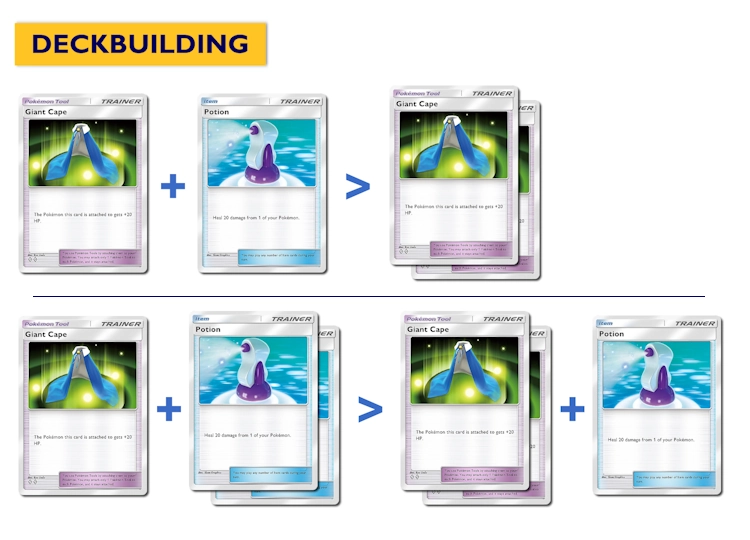
Ah yes, everyone’s new favorite card; and rightfully so, 20 HP is a literal lifesaver! One thing I see a lot of decks do though is run 2 copies of Giant Cape and no other healing. While that’s ok, folks shouldn’t forget about the OG healing card as well: Potion. Cape is a better Potion in a lot of cases, not only does it heal, but it allows you to survive bigger hits as well. I know there are some interactions with cards like Weavile ex and Cyrus that make Potion better, but those are too few to be relevant right now in my opinion. One thing Cape doesn’t do, however, is that it can’t heal the same Pokémon twice.
Maybe you’re trying to consistently survive a breakpoint. Maybe you’re trying to activate a card like Skarmory. In a lot of cases though, running 1 Giant Cape and 1 Potion is better than running 2 Giant Capes instead; that way you have the flexibility to double up healing on your main sweeper instead of only being limited to 20 HP. I would argue as well that in a meta of chip damage instead of big hits (I’m looking at you Darkrai), the advantage of bringing your HP total above what it was is not that important.
If you’re running 3 healing cards, I would say 2 Potion and 1 Cape is better most of the time as well for the aforementioned reason of now being able to heal something up thrice (or twice and something else once). This is all meta dependent though and sometimes you need to be able to survive bigger hits, it will depend on the Pokémon in your deck and what is popular, but it's certainly something to think about when choosing what cards to put in your decks.
Playing with Giant Cape and Potion
As a general rule:
- If you run both Potion and Giant Cape in your deck and only have 1 Cape, then you should use Potion first if you have to choose between both cards since Cape gives you more flexibility.
- If you have 2 Capes in your deck, then you should use 1 Cape first before any Potions since you may not have the luxury of being able to use 2 Capes later on.
What I do notice folks doing a lot of times is panic healing. What’s panic healing? You know those times when you don’t really have a good play so you just Sabrina but you realize immediately after that doing so helped your opponent more than it hurt them? Yeah, something like that. Folks are so afraid not to play cards sometimes (maybe because of Red Card) that they play cards for the sake of playing them.
If you have a 120 HP Pokémon and are staring down a 100-damage attacker, there’s no point in playing Cape in that situation, it doesn’t get you to a particular breakpoint and you’re dying in 2 hits regardless. It’s a lot more nuanced than that in most games, but you get what I mean – don’t panic and calculate possible damage instead of just playing it for no reason.
Pokémon Communication
Deckbuilding theory

Pokémon Communication is a great card that really helps with consistency, but I would caution against always running 2 copies. For decks that only need to set-up one evolution line (ex. Gardevoir with Mewtwo or Serperior with Celebi), I’m not sure you really need 2 of them since normally after you set-up one line, you don’t really need to set-up the other one.
The thing about Pokémon Communication is that it doesn’t really get you card advantage since you’re just replacing one card with another. After you set-up your one line, it’s effectively pretty useless which hurts your draws. Even something like Mythical Slab that’s conditional at least has a chance to get you card advantage and information when it doesn’t; I’d think of running 2 Slabs before Communications usually.
Now, if you need to evolve multiple lines or you run something like Garchomp that can turn Communications into card draw with its ability, then I would run 2 in my deck. Ultimately, it will depend on your deck so don’t be afraid to only run one copy despite how powerful the card can be.
Play with Pokémon Communication
Now, this is what I’m really passionate about because of how much I’ve played it and learned. I’ve been running a Garchomp deck with 9 total Pokémon and I’ve come up with a few pointers for folks.
- You should only play Pokémon Communication on the turn that you can possibly utilize what you get.
I cannot stress this enough. The effectiveness of Comms comes from when it has a smaller pool of cards to select from. This means that you should wait on playing it for as long as possible to maximize the number of Pokémon you could possibly draw in your succeeding turns, so that when you do play Comms, there’s a higher chance of getting what you want. There’s no point in trying to fish for that Stage 1 or 2 Pokémon when you can’t evolve your Basic yet anyway, it’s not like Comms gives you card advantage; just wait and you might draw another Pokémon in your succeeding turns, thereby reducing your pool.
Use case
When I play my Garchomp deck I’m constantly counting the Pokémon I still have in my deck so I know what my odds are (just subtract your total Pokémon from those in play, in your discard pile, and in your hand). Let’s look at an example:
I have 9 Pokémon in my Garchomp deck. Of the 9 Pokémon, I have a Gabite in play, a Farfetch’d on my Bench, and a Gible in my hand; that’s a total of 4 Pokémon drawn – Gabite (1) + Farfetch’d (1) + Gible (2). I need my Garchomp and I have 2 copies in my deck. If I play my Comms now, then I have a 2/5 chance to get my Garchomp which is 40%. If I can afford to wait a little longer though and I end up drawing another Pokémon, then all of a sudden, I have a 2/4 chance which is now 50%. Much better sounding odds.
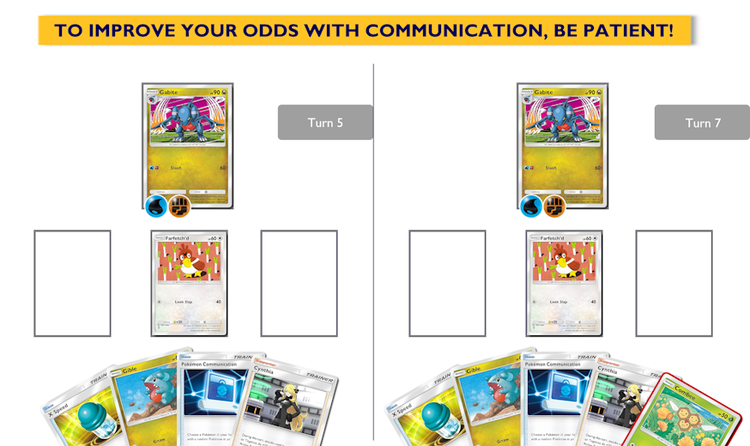
Multi-color decks like Garchomp are even more interesting because I need to make sure my energies line up also before I can attack (or maybe your single energy type Pokémon just doesn’t have enough energy to attack); in those cases I might wait a little longer since I can’t attack yet anyway even if I do evolve it – granted sometimes I need the extra HP or the ability. Ultimately, waiting as long as possible gives me the best chances for success… that is until I get Red Carded. 😊
- Try not to use it for Basics if you can help it.
This is not always an option, but the reason you don’t want to use it on Basics is because you probably have Poké Ball to fish for them, so saving Comms for that evolution line may be better. Speaking of Poké Ball, a neat trick if you’ve already drawn all your Basics and have a Ball in hand is to use Comms on the Basic so you can draw the Basic after and utilize Ball. Card advantage.
- Plan your Comms fodder.
Don’t vomit all your Pokémon onto the board unless you need to, try to save something to use for Comms (fodder). When given a choice, it normally makes the most sense to throw away higher Stage Pokémon since you’ll have more time to draw them back and evolve when you need to. That being said, try not to use the higher Stages of the Pokémon you want to evolve, it’s too risky to throw it out when you’ll need them if you succeed (unless they’re duplicates)
- Learn your probabilities.
This is really just expounding point #1. In my example where I had a 2/5 chance of drawing Garchomp, my probability of success then was 40%. If I have 2 Comms in hand though, then suddenly, my chance of success is now 64% (the formula here is 1-60%*60% = 64%), that’s a lot better. Ultimately the choice to play it that turn or not will depend on how the game is going and how desperate you are, but knowledge of basic probabilities will always help you make an informed decision.
Closing statement
That’s it for now! That was a long one, but hopefully this helped someone out. You can probably tell I’ve spent a lot of time playing Pokémon Communication. Happy coin flipping everyone!