

Loading...
In Pokémon TCG Pocket, you only get one Supporter per turn so when it’s time to play one, you better make it count. When it comes to drawing cards, two names come to mind: Professor Oak and the newly released Iono.


These two might be on the same team, but they play very differently:
- Professor Oak (officially Professor’s Research but come on we all call him Oak) just hands you 2 fresh cards, no questions asked.
- Iono, on the other hand, is a bit more dramatic. She makes you shuffle your entire hand back into the deck, then lets you draw the same number of cards you had.
So, who should you trust when you’re digging for a specific card? Is it better to go with Oak’s, 2-card draw, or take a chance with Iono and her full-hand reshuffle?
Rule of Thumb: When to Trust Oak, and When to Go Iono Mode
If you’re fishing for a specific card, both Oak and Iono can help but which one works better depends mainly on two things: deck size and hand size.
Play Oak when your deck is small
Oak always draws 2 cards. The fewer cards in your deck, the better your odds of pulling what you need. Simple and reliable.
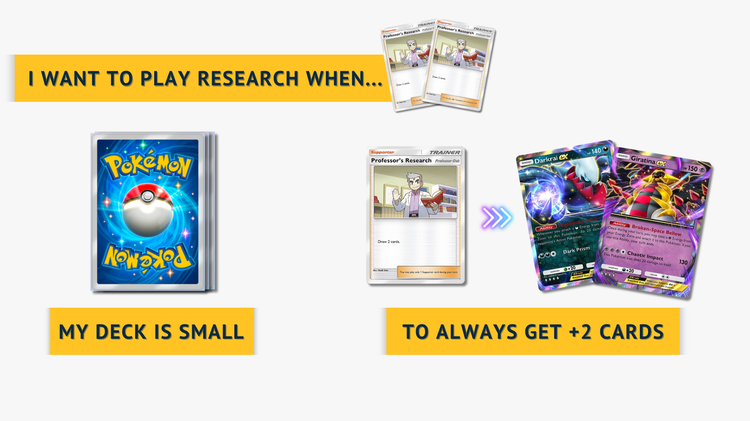
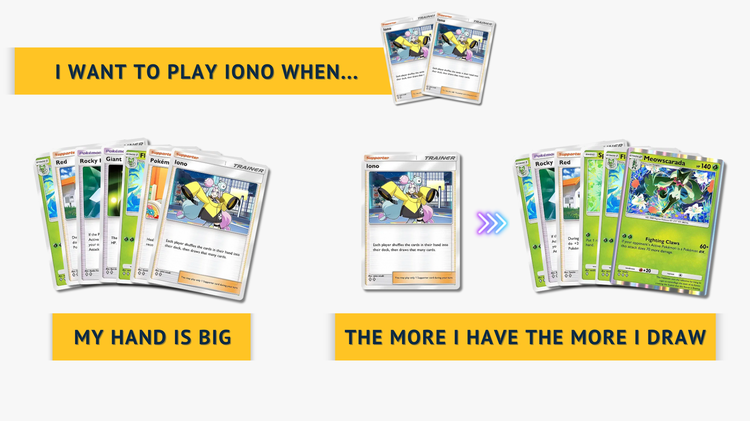
Play Iono when your hand is big
Iono draws the same number of cards as your current hand size. So, if you’re holding 7+ cards, you get a fresh 6-card shot at your target, great for late game digs. The more cards you have in your hand the higher your odds are with Iono even though you have a chance of redrawing the same card (Check the sections ahead).
Crunching the Numbers: Which Supporter Actually Gives Better Odds?
Of course, rules of thumb are helpful, but we wanted to know the actual odds. How much better is Oak when the deck is small? Just how powerful is Iono when you have 7 cards in hand?
To answer these questions, we built a probability calculator in Google Sheets to simulate different game situations: https://docs.google.com/spreadsheets/d/1WbC7SYMtcsl5b9dobNV1nZtDDvXwtUgV/edit?gid=2079493446#gid=2079493446
First, make a copy of the spreadsheet locally so you can use it!
Then, you just plug in three numbers: your current deck size, your hand size (including Iono), and how many copies of the card you're searching for aka number of hits. The calculator then shows your chance of drawing that card with either Oak or Iono.
Some results lined up with expectations, but others were surprisingly counterintuitive. For example, in a few fringe cases, Oak outperforms Iono even with a bigger hand. And sometimes, Iono works better than expected even with fewer cards.
Let’s walk through some of these scenarios and see how the math plays out.
Scenario: Looking for the elusive Stage 2
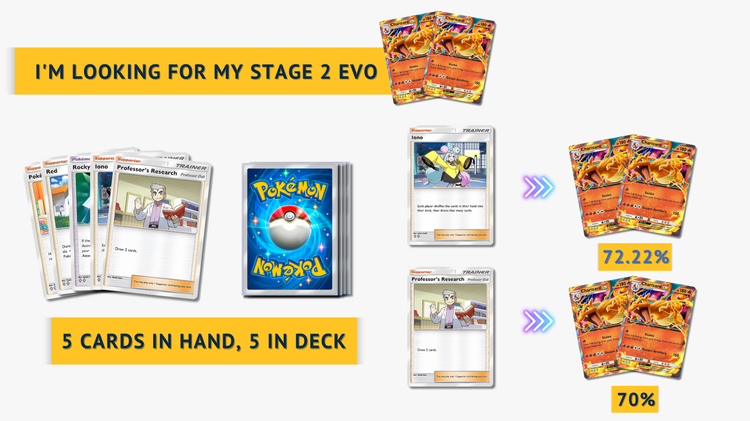
It’s the late game. You’ve got 5 cards left in your deck, 5 cards in hand, and you're desperately digging for one of your two remaining Stage 2 Pokémon.
At first glance, it’s not obvious which Supporter will give you better odds. But when we plug the numbers into the calculator:
- Oak: 70%
- Iono: 72.22%
It’s a close match, but Iono edges ahead just barely by around 2%.
Now let’s add a twist.
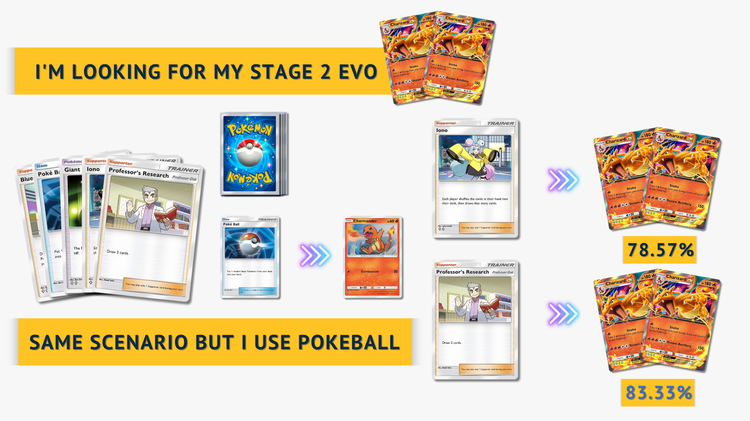
Suppose you also have a Poké Ball in hand, and you know there’s a Basic Pokémon in your deck. You decide to play the Poké Ball, grab the Basic, and thin your deck by 1 card. Now, you're down to 4 cards in deck, still 5 cards in hand.
Time to recheck the odds:
- Oak: 83.33%
- Iono: 78.57%
Surprise! Oak now pulls ahead by about 5%. And interestingly, both options improved just by thinning the deck by 1 card.
For more details about deck thinning and sequencing in general, a good read is ManaT's article to improve your odds at drawing a specific card.
Should You Always Keep More Cards in Hand for Iono?
Is it always better to have more cards in hand when playing Iono? Or should you play some cards beforehand to avoid redrawing things you don’t need?
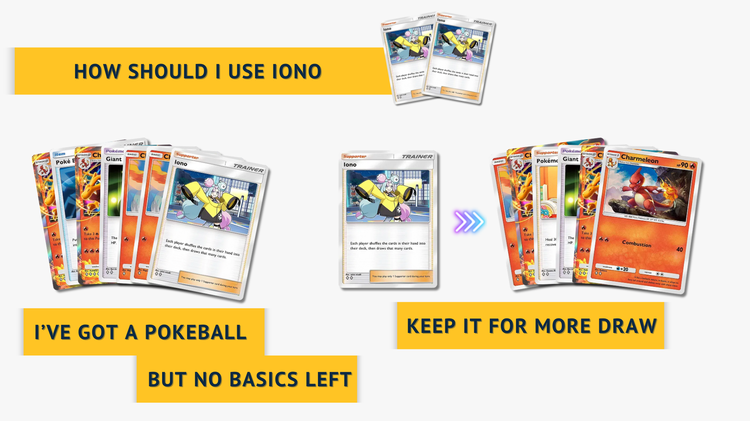
Let’s say you have a Poké Ball in hand, but there are no Basic Pokémon left in your deck. Should you play the Poké Ball just to get it out of your hand, or keep it as “fodder” so you draw one extra card with Iono?
The answer is: Keep it. Always.
Even if it’s a dead card, it still increases your hand size meaning Iono will let you draw one extra card, and that improves your odds.
If you check out the second sheet in the calculator, you’ll see a graph that shows how the probability of hitting your target increases with hand size. No matter your deck size or how many copies of the card you're searching for, more cards in hand = better odds with Iono. Always.
For the Math Curious: What’s Going On Under the Hood?
If you're the kind of player who likes to know why the odds work the way they do, here's a little peek into the math behind the calculator.
Let’s walk through a simple example.
Say you have 10 cards left in your deck, and you're holding Professor Oak (Professor’s Research). You're hoping to draw at least one copy of your Stage 2 Pokémon, and you know that 2 copies of it are still in your deck.
To figure out the probability of hitting at least one, we take a classic probability approach:
First, calculate the chance of drawing zero copies, then subtract that from 1.
Step-by-step:
- There are 2 copies of your desired card, so there are 8 cards that are not hits.
- You’re drawing 2 cards with Oak.
- The number of ways to draw 2 non-hit cards out of the 8 is written as 8C2. This is shorthand for a mathematical concept called combinations: it counts the number of ways to choose 2 cards from a pool of 8, without caring about the order.
- The total number of possible 2-card draws from the full deck of 10 cards is 10C2.
So, the probability of success is:
1-(8C2/10C2)
This formula can be generalized for any situation using three variables: Deck Size, Hand Size and Number of Hits
And that’s what powers the calculator!
Don’t worry if this sounds like a lot, you don’t need to memorize it. But if you’ve ever wondered how the numbers work behind the scenes, now you know!
Conclusion
At first glance, Oak’s steady 2-card draw might seem underwhelming next to Iono’s flashy full-hand shuffle. But as we’ve seen, context is everything. A smaller deck favors Oak’s precision, while Iono shines when your hand is big, and the deck still has room to hide your prize.
Whether you’re playing it safe with Oak or rolling the dice with Iono, the real power comes from understanding when to play which. And now, with a trusty calculator and a pinch of probability, you’ll be able to make that call with confidence.
So next time you’re staring down your opponent with one Supporter to spend, trust the math, trust your gut, and may your next draw be exactly what you need.