

Loading...
With the launch of the new set A3 – Celestial Guardians, one of the most anticipated cards is finally making its debut in Pokémon TCG Pocket: Rare Candy. This iconic item card has long been a staple in traditional Pokémon TCG formats, enabling players to skip the Stage 1 evolution and jump straight from Basic to Stage 2.
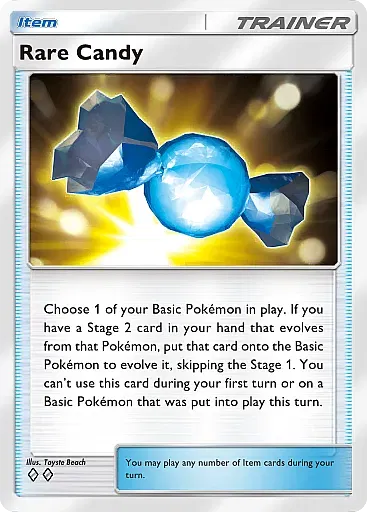
Earlier this week, my co-author Trapinch3D explored "Which Pokémon benefit the most from Rare Candy in TCG Pocket?"; highlighting the new possibilities the card unlocks.
Today, we take the conversation one step further: how should you actually build your deck around Rare Candy? Should you fully commit to Rare Candy and cut Stage 1s entirely? Or should you still include Stage 1 Pokémon to improve your consistency when Rare Candy doesn’t show up on time?
In this article, we'll dig deep into the probabilities, comparing three different deck-building strategies:
- Playing 0 Stage 1s
- Playing 1 Stage 1
- Playing 2 Stage 1s
We'll see not only which path is statistically the most consistent, but also why sometimes, a little inconsistency might just make your deck way more fun to play.
Setting the Stage: Understanding the Setup
When going first:
- You start with 5 cards in hand (including a guaranteed Basic Pokémon in the Active spot).
- You draw 1 card at the beginning of each turn.
- By the time you’re ready to evolve (Turn 3), you'll have seen 7 cards total (hand + draws).
Our deck for this analysis considers:
- 2× Basic Pokémon
- 2× Stage 2 Pokémon
- 2× Rare Candy
- 1× Pokémon Communication
- Variable number of Stage 1 Pokémon (0, 1, or 2 copies)
This setup represents a typical investment for a Stage 2 line in modern decks.
The key question: By any given turn, how likely is it that you can evolve into your Stage 2 Pokémon, and how does including Stage 1 Pokémon impact that likelihood?
We’ll explore two main evolution paths:
- Rare Candy Path: Basic ➔ Rare Candy ➔ Stage 2
- Traditional Path: Basic ➔ Stage 1 ➔ Stage 2
Additionally, Pokémon Communication acts as a flexible tool to swap Pokémon in hand for the right one from the deck, giving even more lines to reach the Stage 2!
Methodology
To calculate the probability of successfully evolving into Stage 2 by any given turn, we first broke down the problem into manageable parts.
The five key variables
There are five important factors that determine whether an early evolution is possible:
- Number of Basics drawn (0 or 1)
- Number of Stage 1s drawn (0 or 1)
- Number of Stage 2s drawn (0, 1, or 2)
- Number of Rare Candies drawn (0, 1, or 2)
- Number of Pokémon Communications drawn (0 or 1)
By accounting for all possible combinations of these draws, we could model different game states that a player might face.
Conditions for Success
For our calculations, we defined a combination as successful if it enabled evolving into Stage 2 by any given turn through one of the following routes:
- Rare Candy Path: Having a Basic Pokémon + Rare Candy + Stage 2 in hand.
- Traditional Path: Having a Basic Pokémon + Stage 1 + Stage 2 in hand.
- Communication Path: Using Pokémon Communication to have a chance to fetch a missing piece (such as a Stage 1 or Stage 2) to complete the evolution. We accommodate the odds of fetching the right piece with Pokémon Communication in any given scenario.
Simulation and Heuristic
Instead of manually calculating each probability, which would involve dozens of tiny cases, we wrote a script to simulate every possible valid combination. The script:
- Enumerated each possible combination of draws.
- Checked whether each combination met a success condition.
- Summed the probabilities across all successful combinations.
This approach allowed us to accurately estimate success rates under different deckbuilding choices (0, 1, or 2 Stage 1 Pokémon included), while keeping the calculations manageable and trustworthy.
Results
The simulation revealed clear trends in the probability of achieving a Stage 2 evolution by each turn, depending on the number of Stage 1 cards included in the deck in addition to 2 Rare Candy. The key findings are summarized below:
| Turn |
Your Turn |
0 Stage 1s |
1 Stage 1 |
2 Stage 1s |
|---|---|---|---|---|
| 3 | 2 | 44.66% | 51.16% | 56.11% |
| 5 | 3 | 55.44% | 61.45% | 65.69% |
| 7 | 4 | 65.38% | 70.49% | 73.80% |
| 9 | 5 | 74.15% | 78.17% | 80.54% |
| 11 | 6 | 81.58% | 84.52% | 86.04% |
| 13 | 7 | 87.60% | 89.59% | 90.44% |
| 15 | 8 | 92.23% | 93.46% | 93.84% |
| 17 | 9 | 95.59% | 96.28% | 96.36% |
| 19 | 10 | 97.82% | 98.16% | 98.11% |
| 21 | 11 | 99.15% | 99.28% | 99.21% |
| 23 | 12 | 99.79% | 99.83% | 99.79% |
Note: In real games, additional outs like Professor’s Research and Poké Ball often make the odds slightly better than what's shown here. However, for clarity and focus, the analysis isolates the effect of Stage 1 counts alone
The results show that:
- Including one copy of a Stage 1 Pokémon provides a noticeable boost in consistency, especially during the early turns.
- Adding a second copy of Stage 1 continues to improve consistency but with diminishing returns compared to the first copy.
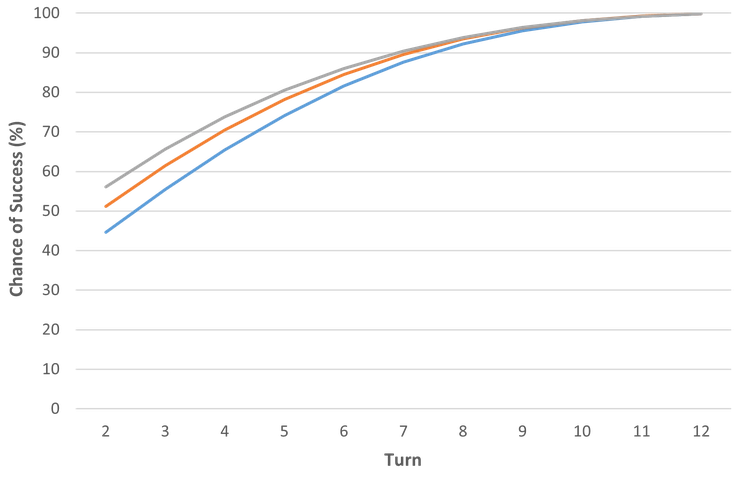
- By Turn 3, the first turn to evolve your Pokémon, the probability of evolving into Stage 2 rises from 44.66% (no Stage 1) to 51.16% (one Stage 1) and 56.11% (two Stage 1s).
To better illustrate these trends, here’s a visual graph showing the probability of completing a Stage 2 setup by each turn, based on the number of Stage 1s included:
Chances of assembling a stage 2 Pokémon
Analysis and Discussion
- Including a single Stage 1 Pokémon provides a significant consistency boost. The jump from 0 to 1 Stage 1 offers roughly a 6% increase in Stage 2 evolution chances by Turn 3. This makes a noticeable difference during the early turns when setting up quickly matters the most.
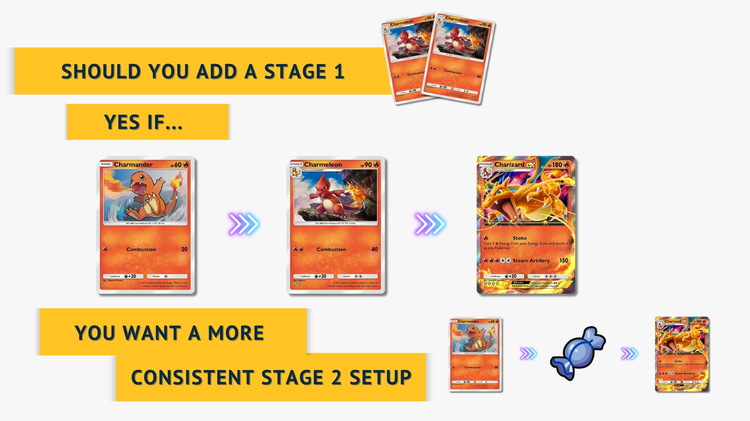
- While adding a second Stage 1 continues to improve the odds, the gains are smaller. Moving from 1 to 2 Stage 1s yields about a 4% additional improvement by Turn 5. This reflects the classic deckbuilding principle of diminishing returns: the first copy covers many bad draws, but the second copy doesn't rescue as many new scenarios.
Importantly, over time, the gap between 0, 1, and 2 Stage 1s shrinks. By Turn 11 and beyond, most players will have evolved into Stage 2 regardless of the Stage 1 count. Thus, the decision about whether to include Stage 1 is most critical for aggressive, early-game decks that want to hit Stage 2 fast, rather than decks that can afford to evolve slowly. - Deck space is a precious resource: including even one extra card means giving up something else. Players must weigh the early-game consistency boost against the potential clunkiness or missed opportunities elsewhere in the deck.
Why You Might Still Skip Stage 1 Anyway
Despite the clear consistency gains from running a Stage 1 for your stage 2 evolution line, there’s still a strong argument for skipping it altogether and it all comes down to fun and simplicity.
When you don’t include a Stage 1, your deck becomes much cleaner for Pokémon Communication plays. With only Stage 2 Pokémon as targets, Pokémon Communication almost always finds exactly what you want. There's no awkward moment where you desperately need a Stage 2, but your Communication grabs a Stage 1 instead!

This streamlined strategy also makes every Rare Candy draw more powerful. When you draw Candy and Communication together early, you can almost guarantee an immediate Stage 2 evolution, leading to fast, satisfying plays.
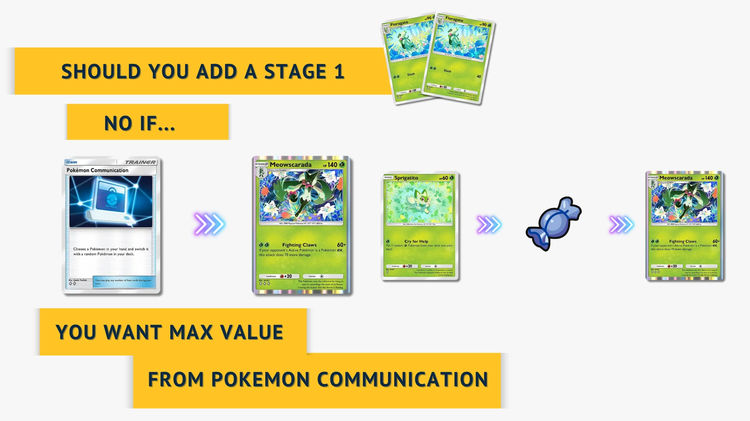
In short, while the math says a Stage 1 is slightly better for consistency, many players will enjoy the smoother, more direct feeling of a pure Rare Candy strategy. Especially for casual and ladder play, this small sacrifice in numbers can lead to a much more fun and less frustrating deck experience.
At the end of the day, whether you add the Stage 1 or go full speed ahead with Rare Candy, the best choice is the one that feels the most fun for you. Build the deck that makes you excited to play; the wins will follow!