

Loading...
When looking to build a deck, players have a guiding motivation (to build around their favorite Pokémon, to beat a solo deck challenge, to create a deck to counter this annoying deck they’ve seen way too much...) and often choose cards to more or less “fill” the twenty slots they’ve been allotted once they’ve added the cards they care about.
When building a deck, you need one you can actually use, to tackle whatever problem you’re facing, right away. A deck you can not currently build is a deck you may aspire to have, and it may inform your decision of which packs to open, but a deck is not an exact blueprint that can easily be filled in with substitutions. There are often cards in decks that make or break a deck’s functionality; unfortunately many cards require two copies of itself and especially of their pre-evolutions to justify usage. For example, Silvally derives much of its value from the consistency Gladion provides, as well as Gladion’s indirect effect of thinning the deck, so Silvally decks should always have two Gladion.
Similarly, running an Eevee Box deck is unfeasible without two Eevee and two Eevee ex, because of the need to maximize flexibility, as well as to utilize the many Eeveelutions in the deck effectively. An evolution card that cannot be played is a “dead” card which provides no value to the player, and decks should aim to have no more than one, which would be included for consistency or additional attack opportunities (like a non-ex version of a Stage 2 ex; also of note, Eevee Box breaks this rule because all the cards evolve from Eevee (ex)).


In this article, I will explain how to evaluate a Pokémon card’s worth, since it’s important to recognize that not all cards are created equal; when winning is the goal, there are some Pokémon that—unless a player doesn’t have better options—do not make the cut. Additionally, I’ll mention what makes some abilities and attack effects worth keeping an eye on. Next, I’ll cover the roles a card may take in a deck; if a card is going to occupy one of the twenty slots, it should be there for a reason.
On-Rate and a Pokémon’s Value
Firstly, what is an “on-rate” card? Well, a Pokémon has obvious stats linked to the energy costs of its attack, namely the damage. Through comparing the efficiency of an attack relative to the cost, a basic hierarchy for how good Pokémon are can be established. Although Pokémon should be evaluated in their entirety, factoring in both the health and retreat cost, I find it helpful to isolate attack damage since it is one of the simpler markers of a good card. Let’s make an assumption that the Pokémon in question is not an ex, as most ex do something unique and don’t simply hit for a set amount of damage. Additionally, we'll only be focusing on the terminal Pokémon in an evolution line, be that a Basic, Stage 1, or Stage 2, since previous evolutions usually fall below the bar of an on-rate attacker, helping to keep Pokémon competitive that don’t have the advantage of evolving further. An on-rate Basic attacks at a flat rate (flat meaning with no additional effects) of forty for one energy, a Stage 1 fifty for one energy, and a Stage 2 seventy for one energy. A good rule of thumb is twenty more damage than the damage number for one energy, for each additional energy on the attack cost.
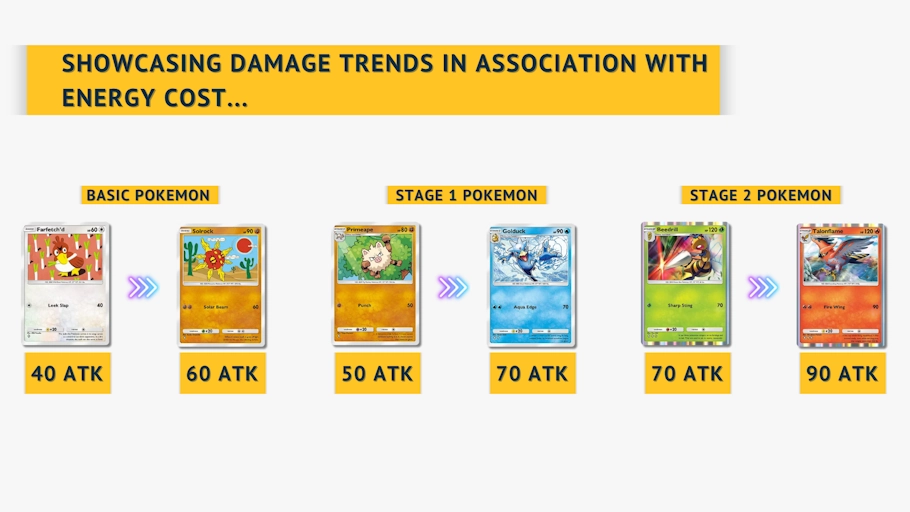
Caution though, a card being on-rate doesn’t mean it’s a must have in your deck, rather it meets the bar for usage. Farfetch’d is a good example; it is a very efficient early game attacker, but in the current state of the game its low health means it dies too quickly, significantly curbing the benefits of its cheap attack.
Card Archetypes
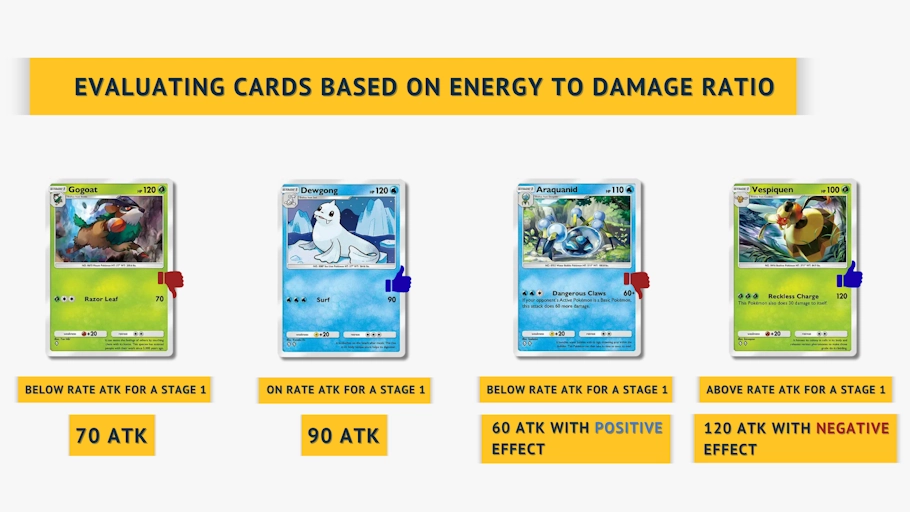
Now let’s discuss card ‘archetypes’. With “on-rate” defined, some trends are noticeable: many of the more frail Pokémon attack for cheaper and have smaller retreat costs. Other cards have strangely low attack damage, like a Stage 1 that does seventy damage for three energy; such cards can safely be evaluated as pack filler. A lot of Pokémon deviate from what is considered on-rate but offer a unique attack effect: if it attacks better than on-rate it will likely have a drawback, like energy discard, and if it attacks worse than on-rate it will likely have some sort of benefit, like applying a status condition or other effect. A balance must be struck between the loss or gain of damage and the benefit or detriment of the attack’s effect. If a penalty is too harsh, it may mean the great damage isn’t worth it, while if an effect is lackluster, it’s likely not worth putting up with mediocre damage to have it. An additional measure of attack effects is how easily they come into play; useful effects on a three energy attack likely won’t save bad damage due to the steep investment to attack in the first place.
There are also many conditional cards that attack for better than on-rate damage, but require the game state to be a certain way, such as your opponent’s Pokémon being poisoned, or the opponent’s Pokémon being an ex. If a conditional attack isn’t reliable, especially if it depends on something completely out of your control, it may not be worth making room for that Pokémon in your deck. To achieve the best possible results with a conditional attacker, the rest of your deck should be built with achieving that condition in mind. Poison decks greatly benefit from flexible and consistent sources of poison such as Weezing Genetic Apex or Grafaiai, while Silvally decks typically employ at least seven Supporter cards to ensure Silvally is attacking for max damage as frequently as possible.
If a Pokémon isn’t valuable for its damage, there are two ways it may be able to make up for it. First, if the Pokémon has an attack effect like Manaphy, which attaches Energy to up to two benched Pokémon, it may be worth including. Manaphy specifically has a low HP of fifty, so players should expect it to have limited staying power, and since it requires one energy to attach two, if it only attacks once the tradeoff is one additional energy for one lost point. However, if Manaphy can survive long enough to attack twice or more, the value of energy ramping increases significantly.

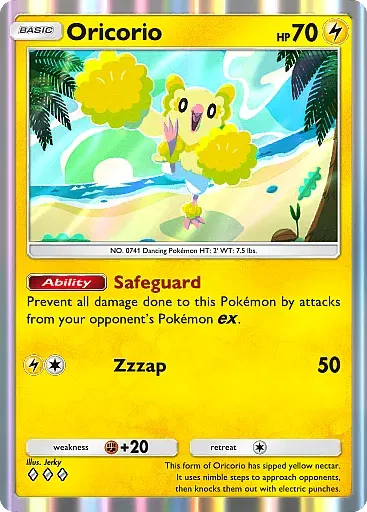
Second, if that Pokémon has a useful ability, like Oricorio, which is invulnerable to all attack damage from opposing exs, it’s reasonable to ignore mediocre stats. These sorts of Pokémon which are valued for their attack effect or ability fall under the category of utility cards. While they typically are not the main damage dealer of a deck, they can enable a damage dealer to get a clean knockout, stall until one is ready, or help put energy on a damage dealer to get it able to attack faster.
I’ve found that it is best to not judge Pokémon which flip coins to attack by their maximum damage output; instead, determine the average and judge based on that. However, expect that during actual play, sometimes that Pokémon will hit for less than that average value, failing to kill an opponent’s Pokémon in time, or over-perform, getting an unexpected knockout, or worse, doing more damage than needed (it feels terrible to “waste” luck).


Tsareena Celestial Guardians does an average of seventy five damage, so it’s a very strong and efficient attacker, but will be less consistent than a similar option like Beedrill who will hit for seventy every time.
The Economics of Pokémon Decks
If you’ve been paying attention, you may have noticed words like “investment” or “value” in my descriptions of Pokémon or cards. This is because when judging a Pokémon or card, everything comes down to how good or bad it is in comparison to other Pokémon or cards. Furthermore, Pokémon require different levels of investment to pay off, such as evolving, or attaching a greater number of energy. The ease with which a Pokémon can pay off is the opportunity cost, or in other words: with all the resources required for a Pokémon to pay off, what else could you have done? What other cards could you have attacked with, would you still be looking for another evolution by that point in the game using a different Pokémon? What other cards, particularly Trainers, could you fit if you didn’t include that Pokémon?
Still, there are some realities of deck building that should be kept in mind. If the number of Basic Pokémon in a deck is increased, Poké Ball will be less reliable when searching for a specific Basic, while an increase in the total number of Pokémon will likewise make Pokémon Communication less reliable when searching for specific cards. Multiple evolution lines dilute the focus of your deck, creating potential conflict in energy placement, and cards from an evolution line you can’t use are dramatically less useful than a Trainer card. As a rule of thumb, decks should have no more than two separate evolution lines, with a preference against two Stage 2 lines in general, due to the heavy demand on deck space from such a deck (double Stage 2 decks require at least seven usually have nine Pokémon in addition to two Rare Candy).
While some cards can increase the consistency of which a Pokémon is available to be played, like Poké Ball, in general the best tool to control the consistency of a specific card’s impact is the number included in the deck. One or two copies of Trainer cards should be used depending on the frequency of usage and need for consistent access, as having two will help to ensure that you get at least one copy early on in most games. Similarly, by controlling the number of Basics in a deck, you can influence how likely it is to start with a given Pokémon, and how likely it is to start with one or more Basics in your hand—in decks where it is important to open on a particular Pokémon, consider removing some extraneous Basics to raise that likelihood.

Next, always begin deck building by grabbing the staples: two Professor’s Research and two Poké Ball are automatic must-haves for almost all decks, and most decks will also need one gust (either one Sabrina or one Cyrus). Similarly almost all Stage 2 decks should run two Rare Candy to accelerate the speed at which the Stage 2 comes into play, as well as raise its consistency of appearance. Note that both Professor’s Research and Poké Ball as well as a variety of useful Trainer cards are available for purchase in the in-game shop, so make sure to pick up two of each if you haven’t already.
Beyond the limit of twenty total cards in a deck, there are many limited resources in Pokémon Pocket. One of the most problematic is energy costs, as a deck full of high attack cost Pokémon will struggle to act flexibly and may be forced to commit to a predictable game plan of attaching energy to one Pokémon. Another is turns, since many pre-evolutions are lacking in damage or effect compared to their final evolutions, while other Pokémon, usually ones without evolutions, can begin to attack at their full capability as immediately as they have enough energy. The final resources to keep in mind are health and points, as no matter what you do, if your opponent reaches three points before you, you lose. Furthermore, health is a resource that should be carefully managed; if you can heal a Pokémon to prevent its knockout, you can buy one more turn for it to attack, contribute, or stall. Some decks can take advantage of intentionally spreading out smaller increments of damage Pokémon take in a mindful fashion to prevent important Pokémon from getting one-shot later in the game.