

Loading...
Extradimensional Crisis (A3a) introduces a new type of Pokémon card: Ultra Beasts. All Ultra Beast cards (or should we say Ultra Beats?) feature at least one attack name that references a music genre or style. Interestingly enough, non-Ultra Beast cards do not have any musical references. Read on to learn more about the musical references in the cards, and listen to examples as you go!
Buzzwole ex's Big Beat
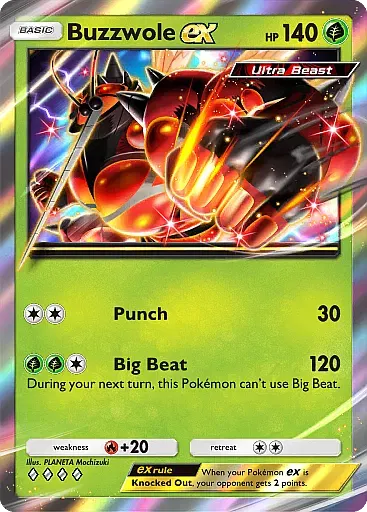
The card Buzzwole ex features an attack named Big Beat, which references a subgenre of electronic music. Big beat is known for its heavy breakbeats and synthesizer loops and became popular in the 1990s through artists such as The Prodigy, Fatboy Slim, and The Chemical Brothers. The attack name is also potentially a clever play on the word 'beast': 'Big Beast!'
Guzzlord ex's Grindcore

Guzzlord ex
Guzzlord ex has an attack named Grindcore, a reference to the extreme metal subgenre known for its aggressive sound and intensity. Grindcore blends elements of heavy metal and hardcore punk, featuring blast beats, distorted guitars, and screamed or growled vocals: a fitting match for Guzzlord, who is often memed for his loud and relentless screaming in the Pokémon anime.
Nihilego's New Wave

Nihilego's attack is named New Wave, referencing the music genre that emerged in the late 1970s and 1980s, most popular in the UK. New wave developed as a more melodic extension of punk and came to encompass styles such as synth-pop, alternative dance, and post-punk.
Blacephalon's Beat Punk

Blacephalon
Blacephalon features an attack named Beat Punk, which likely references the punk rock genre known for its raw energy, fast tempos, and stripped-down instrumentation. The word beat carries multiple connotations here: musically, it refers to rhythm (central to punk and related genres like beatdown hardcore) while also describing the physical action of the move itself.
Celesteela's Moombahton

Celesteela's attack is named Moombahton, a genre of electronic dance music that blends elements of house and reggaeton. The style originated in 2009, when DJ Dave Nada coined the name as a portmanteau of the track Moombah and reggaeton — itself a term combining reggae with the Spanish suffix -ton, meaning “big.”
Poipole's 2-step

Poipole’s attack is named 2-Step, which not only refers to the attack flipping two coins but also references a genre of electronic music. 2-step garage, or simply 2-step, is a subgenre of UK garage known for its distinctive rhythms that avoid the traditional four-on-the-floor kick drum pattern. Instead, it features jittery, irregular beats that create a syncopated, danceable groove. Broadly speaking, the term is applied to any music with a 2-beat rhythmic structure, whatever the initial genre (country, garage...).
Naganadel's Electro House

Naganadel's attack is named Electro House, a subgenre of electronic dance music characterized by heavy bass and a tempo between 125 and 135 beats per minute. Artists associated with electro house include Benny Benassi, Skrillex, Steve Aoki, and Deadmau5.
Pheromosa's Jump Blues

Jump Blues refers to an uptempo style of blues, jazz, and boogie-woogie that emerged in the late 1930s. Often performed by small groups with horn instruments, jump blues was popular in the 1940s and influenced the development of rhythm and blues and rock and roll. The genre saw renewed interest during the 1990s swing revival.
Stakataka's... attacks

Stakataka might be the most interesting card of the bunch, as it has two different attacks. Brass Rock refers to a psychedelic-era subgenre blending rock’s raw energy with jazz’s fluidity. Notable bands in this style include Chicago and Blood, Sweat and Tears.
However, the original Japanese name for this attack, "アシッドハウス", translates to Acid House a well-known electronic dance music subgenre from the mid-1980s. Acid house is characterized by distinctive basslines created using the very recognizable Roland TB-303 synthesizer and gained popularity in Chicago before spreading to the UK and Europe’s rave scenes. The name change may reflect localization choices for a family-friendly US/Western audience.
Demo of the Roland TB-303, the centerpiece of Acid House
Xurkitree's Electronica

With its bizarre, electric-wire-like form Xurkitree is a living testament to its attack Electronica, a broad category of electronic-based music styles focused more on listening than dancing. The term gained prominence in the early 1990s UK music scene, while in the United States it often refers to electronic music in general. Electronica includes a wide range of artists, from mainstream names like Björk, Madonna, and Goldfrapp to experimental acts such as Autechre and Aphex Twin.
Kartana's Trash Metal

Thrash Metal is an aggressive subgenre of heavy metal music that emerged in the 1980s. Thrash metal is characterized by fast tempos, percussive beats, low-register guitar riffs, and shredding lead guitar work.
Dusk Mane Necrozma's Black Metal

Dusk Mane Necrozma's attack Black Metal is an interesting choice of genre, with black metal having satanic roots. Black metal is an extreme subgenre of heavy metal known for its fast tempos, shrieking vocals, heavily distorted guitars, raw recording style, and unconventional song structures. Watch out for this card!
Dawn Wings Necrozma's Psychobilly

Dawn Wings Necrozma's attack Psychobilly refers to a genre of rock that mixes elements of gothic, rockabilly and punk. it's often characterized by lyrical references to sci-fi, violence, and other topics generally considered taboo, and thus continues the trend of unsettling Ultra Beasts in Pokémon TCG Pocket.
Ultra Necrozma ex's Shoegaze

Finally, the first Dragon Pokémon ex of Pokémon TCG Pocket features the Shoegaze attack, a subgenre of indie and alternative rock. Shoegaze is known for its ethereal blend of obscured vocals, heavy guitar distortion, effects, feedback, and loud volume. Originating in the late 1980s in Ireland and the UK, shoegaze bands often performed in a detached, motionless style.