

Loading...
Hi Poké Fam! Are you all ready for the new set?
One of the best parts about new set releases is how many creative decks pop up in the first few weeks while people are still figuring out the meta. While there’s absolutely nothing wrong in copying someone’s list (what we call 'netdecking'), it certainly hits differently when you do well with your own homebrewed list.
In a game like Pokémon Pocket, where decks are only 20 cards, deckbuilding becomes much more important because you’re very likely to draw all or most of your cards. Conversely, games with larger decks have an emphasis on your play since games will play out with a lot more variances given the number of different cards.

My goal with this article is to share with you how I approach deckbuilding and the thought process behind my choices. While the focus will obviously be on deckbuilding, we’ll touch on card analysis and meta analysis as well. We’ll also use a Lunala Giratina list I crafted and used to get to Master Ball this season as an example. While this is not the definitive guide to deckbuilding, you might find some tips that you can adapt to your style. Now buckle up, there’s a lot to go through!
Starting Out – Core and Complements
For those that play the mainline Pokémon games and follow the VGC scene (that’s the official battling format), you’ll know that you should always start with a core which is a Pokémon or a few Pokémon that you want to build around. It’s the same concept for deck building. It can be your favorite Pokémon, a rare card that you pulled, or maybe a pair of Pokémon that you think work well together; pick something out and start from there! Do know however that not all cards are made equal, so while you can certainly build a deck around anything, the strength of the deck will depend on the Pokémon you choose. Sorry Garbodor fans!

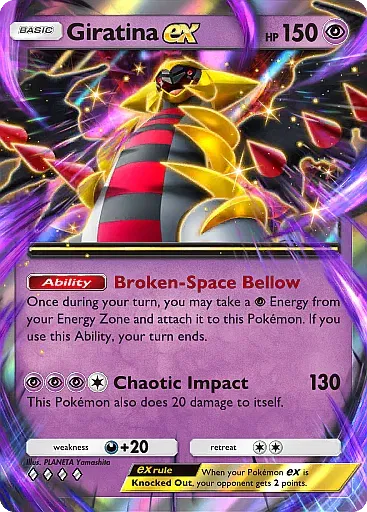
In my case, I immediately gravitated towards Lunala and Giratina Ex as not only were they some of my favorite legendary Pokémon in the games, but they had synergy together too. Obviously, I wasn’t the only one to spot this combination, but there are some variations between the different Lunala / Giratina Ex lists, and this was how I came up with mine. While the next step is really just identifying strengths and weaknesses, I phrase it a little differently to better focus my thoughts:
- How do my cards “cheat” or break the game? These are your win conditions, and you need to get to them as quickly and consistently as possible.
- What do I need to shore up and cover for? This is based on what’s showing up in the meta.
By answering the two above questions, you’ll usually arrive at an initial list that you can start off with. Here was my thought process for Lunala / Giratina.
How do my cards “cheat” or break the game?
- Giratina Ex's Broken-Space Bellow cheats energy at the expense of being passive in the early game meaning I can use expensive attacks sooner, and Giratina Ex hits hard.
- Lunala ex can take advantage of Giratina Ex’ ability and shift the energy that Giratina Ex generates onto another Pokémon.
- Taking the previous point one step further, if I combine Lunala’s ability with free retreats, then I basically don’t lose energy momentum, and I can keep using expensive attacks every turn after I get rolling. This led me to my first set of complements – Leaf and STS Giratina, both of which allow me to have “free retreats.”


What do I need to shore up and cover for?
- Lunala ex is a Stage 2 Pokémon which is naturally inconsistent, so having 3 Stage 1’s (Rare Candy + Cosmoem) will help me get it out more consistently.
- Oricorio is quite popular and most of my Pokémon are Ex’s; luckily, I already decided to include STS Giratina who one-shots the cheerleader.
- Giratina Ex and expensive attacks naturally lead to a more passive early playstyle, so I want to be able to do something early game – Poison Barb not only punishes them for attacking but keeps the damage going even when I switch out which is what I’ll be doing a lot.
- Giratina Ex is actually quite squishy after it attacks once given the other threats in the meta –starting by an opposing Giratina ex– so adding a Giant Cape which “heals” before attacking can keep the dragon slug alive.
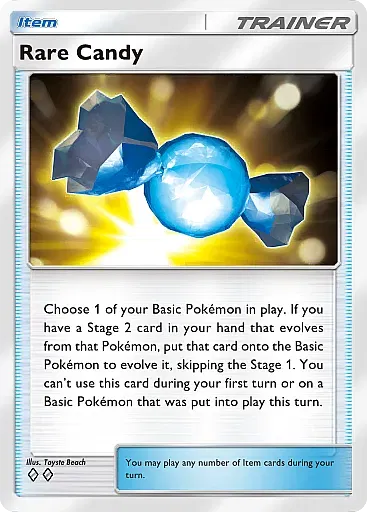


If you’ve been keeping track, then just by answering both questions, I pretty much arrived at almost 20 cards when adding staples like Poké Ball and Professor’s Research. I can now jump in and see how my list does.
Playtesting and Iterations
This is the most important and difficult part of the deckbuilding process. It’s unfortunate that a lack of rank floors in Ranked Mode discourages playtesting but knowing how to iterate your initial list is critical if you want to succeed. Don’t always scrap your list after a string of losses: sometimes, it just takes a few card swaps to arrive at a much more powerful list. You have to know how to attribute losses as well – was it the list, mistakes in your play, or did your opponent just get lucky with RNG? Learning the difference between the 3 takes practice and time to review the Battle Log. Here’s a hint though, it’s rarely RNG’s fault. 😊
Useful Tip: When you’re considering replacing a card in your list that you have 2 of, you can use a version with a Flair or a different art for one of them. That way when you draw that card, you can imagine it’s the card you want to replace it with and ask yourself if that’s better.
List 1: Batman Begins
This was the initial list I jumped into ranked with. Apart from the Core + Complement cards that I arrived at, the only other card added was Mewtwo ex. The thought process behind it was that Giratina Ex + Mewtwo ex had some success last set, and I wanted to flex the fact that I had a gold copy… so sue me.
From my initial 10 – 20 games, a few things stood out to me.
- The Lunala ex / Giratina Ex combo felt really powerful when it came together, the problem was getting the pieces consistently and early enough.
- Darktina gave me the most problems. If I didn’t get Lunala ex or Mewtwo ex online early, they would typically get the knockout first. I could revenge kill, but their 2nd Pokémon would then come in to clean up after that. Their chip damage means they got the knockout with one attack while nothing other than Mewtwo could do the same.
- My tools felt like they underperformed. It felt like I either knocked out with one attack, or it took two attacks regardless of the Poison Barb damage. It didn’t help that Darktina ran Guzma and heals to get out of range as well.
List 2: The Dark Knight
Changes:
- (+) Mythical Slab to get my pieces more consistently. I’ve been a Mythical Slab fan for a while now and most of my wins came from assembling Lunala and Giratina Ex early.
- (+) Tapu Lele to deal with Darktina and to make Slab more consistent.
- (+) Cosmoem and (-) Rare Candy to make Mythical Slab more consistent while still maintaining the 3 “Stage 1” cards.
- (-) Poison Barb and Giant Cape because they just didn’t feel like they were doing much for me.
This was the first iteration of the list and represented an all-in on Mythical Slab basically with more than half the deck being Pokémon. Again, I played another bunch of games, but unfortunately this list felt even worse than the original list.
- Since I had so many Ex Pokémon in my deck, Tapu Lele felt like a bad card for me. It was awkward to bring in since it was easy to knock out which often lost me the game, and my problem of not getting the first knockout was still there.
- Having Tapu Lele also meant my Poké Balls were less consistent at getting the 2 Basics I wanted early – Cosmog and Giratina Ex.
- While having double Cosmoem made Mythical Slab better, I lost the speed that Rare Candy brought. Going 2nd with Lunala in front of a Giratina Ex on the bench was one of my most powerful starts since it allowed me to attack on my 2nd turn and get an early knockout. Evolving through Cosmoem was too slow.
List 3: The Dark Knight Rises
Changes:
- (-) Tapu Lele and 1 Cosmoem; while this makes Mythical Slab less consistent, running 9 Pokémon is still about half my deck and Mythical Slab is good even when it doesn’t draw you a card anyway since it gets you closer to your Pokémon. It’s still a keep for me in my deck, and I felt it won me games even if it wasn’t as flashy as something like a Cyrus or Lillie.
- (+) Rare Candy for the powerful early Lunala with Giratina Ex combo. It helps also when you draw Cosmog late since it lets you get to Lunala in 1 less turn.
- (+) Red – can’t believe I forgot about this card. With Darktina being my most common difficult match-up, this gave me an extra win condition against them. Now I could either get an early Lunala that could tank a hit, Mewtwo 150 attack to one-shot, or Giratina with Red to one shot.
I felt the changes immediately. I don’t have exact my exact win rate, but it felt way better in climbing to Master Ball while fighting a variety of decks. It didn’t feel like I had an unwinnable matchup anymore, and my decisions with the deck felt much better since I had a lot more games under my belt. I knew what win conditions to play for, and I was often rewarded for it.
Building or netdecking?
Before I end, I want to get something straight, there’s nothing wrong with copying a deck you see online. Even “my” iterations are likely influenced by videos I watch or opponents I face. However, succeeding with a deck that I felt like I built through my own experiences is a rewarding experience. We all get enjoyment from the game in our own ways, and this is just one of mine. I hope this guide helped you in some way. Until next time, happy deckbuilding!