

Loading...
In Pokémon TCG Pocket, both Random Matchmaking and Event Matches share a single format for public matches: the Standard format. As the meta stabilizes over the weeks following a new set release, players quickly get bored of facing the same top tiers decks, and most are left waiting for the next expansion to refresh their experience of the game.
Thankfully, the community has risen to the challenge and with Private rooms and community-run tournaments, alternative formats have emerged to bring much-needed variety to the gameplay. Below, we’ll explore some of the most popular non-standard formats that appealed to the Pocket community.
NOEX Format
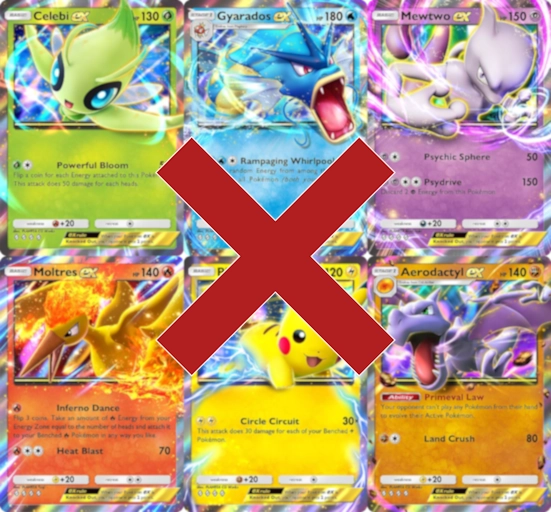
Pokémon ex are a unique mechanic in the Pokémon TCG. These Pokémon are significantly stronger than regular ones but come with a tradeoff: when knocked out, they award your opponent two Points (or Prize cards). Designed to speed up games and add in power level, Pokémon ex are rarer than the regular cards and some players feel they’re less balanced and less enjoyable to play with and against.
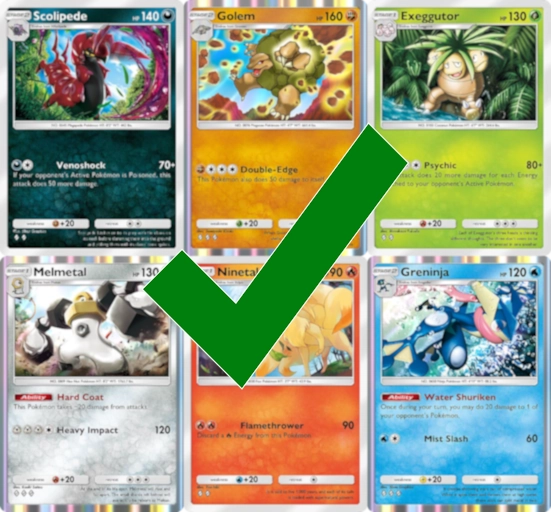
NOEX is an alternative format that bans Pokémon ex entirely. This format draws inspiration from real-life custom formats like Gym Leader Challenge and the game's solo-mode tasks, where players are rewarded for using only cards of rarity or lower (Pokémon ex are the only cards classified as ). NOEX has quickly become one of the most popular non-Standard formats in Pokémon TCG Pocket, supported by frequent tournaments and an active community.
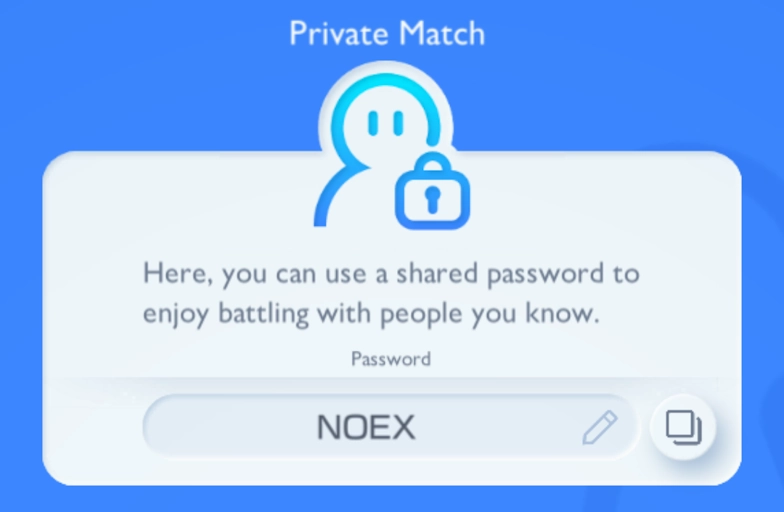
There’s even a permanent NOEX private room available—simply enter "NOEX" as the password in a private match to join. This room is a great place to test your no ex deck against other players.
It turns out that some Standard meta decks such as Brock, Koga or Blaine don’t require any Pokémon ex to begin with, so they’re naturally good picks in this format. Cards like Greninja and Farfetch’d are also staple in this lower-power format where entire typings such as and are pretty much absent.
Richazis, winner of BEC No Ex No Problem (11-2-1, 361 players)
The format is currently dominated by Brock decks, Blaine decks (which thrived in the Genetic Apex format), and Exeggutor decks leveraging the Mythical Island evolutionary line with Serperior for support. Other competitive choices include Koga, Greninja, and Melmetal decks.
Ironically, while many players turn to NOEX to escape the repetitive Standard format, NOEX itself is less diverse than Standard. This comes as no surprise as the game’s designers balance cards with Pokémon ex in mind, not specifically for NOEX. To address this, some tournaments are experimenting with hybrid formats that allow only a few underused Pokémon ex cards.
Singleton Format
Singleton, also known as Highlander, is a popular format in TCGs. It requires players to use only one copy of each card in their deck. In Magic: The Gathering (MTG), less than three years after the first set launched, the Elder Dragon Highlander (EDH) format was created, introducing an additional rule: a Legendary creature acted as the deck’s commander. Today, EDH is the most popular MTG format by far. Similarly, Pokémon TCG has its own Singleton format in the widely embraced Gym Leader Challenge.
While Pokémon TCG Pocket lacks the app functionality to support a commander mechanic, Singleton is still easy to play. The format’s restriction of only one copy of each card makes each game unique and unpredictable.
Haryanto, winner of Little Legends League #12 (7-1, 256 players)
Pikachu ex and Mewtwo ex were the dominant threats of the last formats and rightfully remain so, but Fighting and Gyarados decks are now giving these top-tier picks strong competition.
Singleton in Pokémon faces a unique challenge compared to MTG. Evolution cards depend on other specific cards to reach their full potential. Limiting decks to a single copy of each card makes it difficult to consistently evolve into Stage 2 Pokémon: these strategies start at a disadvantage. In contrast, decks using basic Pokémon ex or strong standalone cards tend to perform better.
Decks with the flexibility to evolve their Basic Pokémon into both a regular form and an ex form also have an edge, as they can bring more reliably and more quickly a stronger Pokémon into the field.
1 EX Format
Many of the best decks rely on not just one but multiple Pokémon ex, such as Pikachu ex paired with Zapdos ex, Celebi ex with Exeggutor ex, or Moltres ex alongside Charizard ex... The ability to consistently access multiple Pokémon ex streamlines the gameplay and puts archetypes with one to no viable Pokémon ex at a disadvantage. To address this, some tournament organizers have been experimenting with a new format where only one Pokémon ex is allowed per deck.
Sashu, runner-up of Narnia’s Pocket League #6 (9-3-1, 218 players)
Unfortunately, the results suggest that this approach hasn’t significantly shifted the metagame from the regular format. Mewtwo ex, along with and decks, still dominate.
Interestingly, the true stars of this format are non-ex Stage 2 allowed as two-ofs, such as Gardevoir, Serperior, and Greninja. These cards have exceptional power levels and pretty much carry their respective types to the top of the competition.


Coinflip Format
Arguably one of the most entertaining formats, Coinflip tournaments only allow cards with coin flip attacks and effects (and their pre-evolutions) to be played. This format embraces pure RNG, turning every match into a chaotic gamble. Whether you rage at your misfortune or revel in being outrageously lucky, one thing’s for sure: no one can accuse you of skill issue!
ZieGuy, winner of Xmas Copa Guapo Meowth #2 (16-0, 103 players)
Multi-Energy Format
The viable decks in Pokémon TCG Pocket are largely mono-type due to the mechanics of the Energy Zone, which supplies Energy randomly. Unlike a predictable alternation of Energy types, the randomness means players might never draw the type of Energy needed to power up their differently typed Pokémon. This heavily discourages multi-Energy decks in competitive play. For example, Dragonite decks, which require at least two different types of Energy, have struggled to achieve any significant form of success in tournaments. To create a more unique metagame, some tournaments require to run 2 or 3 different types of energy in the deck.
Hax, winner of PTCGP League: Triple energy (10-1, 186 players)
The metagame in these formats often falls short of expectations. Many players circumvent the intent of the rule by simply adding a second type of Energy to otherwise mono-type decks, relying on attackers that can function with Energy (such as the Froakie line) or hoping for favorable Energy draws. Alternatively, the format devolves into widespread use of Dragonite or Pokémon decks. Efforts to balance this format with additional restrictions—such as banning Colorless Pokémon, limiting EX Pokémon, or requiring players to utilize all included Energy types at least once—often worsen the initial intent to diversify these tournaments.
Diversifying the Playfield: A Community Effort
The community has shown remarkable creativity in breaking the routine of Standard play, not only by crafting original custom formats but also by supporting them with cash prizes. Entire series, such as the Little Legends League, are dedicated to these unique tournament types.
Ironically, these custom formats end up being less diverse than Standard. Their main appeal then lies not so much in offering a more balanced experience but in delivering a fun and refreshing time. This is also due to the currently small card pool. With future expansions, hopes are high for more diversity added to these formats as well.
In the official Pokémon TCG, non-Standard formats haven’t gained much traction. Expanded is the only other officially supported format, primarily used for side events, while Gym Leader Challenge (created by Andrew “Tricky Gym” Mahone) is another favorite among the community. In TCG Pocket, we're lucky to have a hard-working grassroot community and curious players to experiment with different formats. Until some get noticed and supported officially?