

Loading...
Ranked matches are arriving with the upcoming Shining Revelry expansion, giving even non-tournament players a consistent competitive outlet. Picking the right deck for the new mode is surely going to be a challenge for the vast majority of players, compounded by the fact that the metagame is virtually guaranteed to shift with the new set release. Thankfully, TCG Pocket is not my first ladder monster card game, and I've hit consistent Master Ball-equivalent season finishes in Hearthstone, Marvel Snap, and Eternal using the same methodology for choosing my weapon. Using the current Triumphant Light metagame as a template, today I'd like to share my methods in order to make your climb as painless as possible.
Rule 1: Consistency Is King
In a tournament metagame, the decks with the highest power level and best meta-call matchups tend to have the highest representation. This is possible even in the face of some amount of inconsistency because tournament sets are best-of-3, meaning if you're relying on a powerful Stage 2 evolution, you're more likely than not going to be able to hit your win condition over the course of more games.
This is not the case in ranked. Ranked ladder is (likely) best-of-1, meaning you can just instantly lose to not finding your Stage 2. Gallade EX and Rampardos might be two of the best decks you can bring to a large event to target metagame staple Arceus/Dialga EX, but it only takes one hiccup of a bad draw to lose to a Metallic Turbo -> Ultimate Force wiping your entire team.

Rampardos is particularly vulnerable to inconsistency, relying on a Stage 2 evolution line that can't tutor its first stage with Poké Ball thanks to starting from the Skull Fossil.
Generally speaking, we should be looking to hit our Plan A as often as is feasible.
This is also valuable because some amount of our ranked ladder is going to be unoptimized random nonsense or people wanting to use their favorite Pokémon in their ranked climb regardless of power level. Even some of the weirder Basic Pokémon are statted better than Stage 1s or Basics that can further evolve just based on card design - Kirlia is pretty pathetic even in the face of something like Origin Forme Dialga, let alone the actual strong Big Basics that define strong decks. None of my ranked decks in the first season are going to utilize a Stage 2 evolution line unless the line is so over-the-top powerful it makes no sense not to gamble. And yes, this means despite my ranking Beedrill EX as the most underrated card in Shining Revelry - and giving it a grade to boot - I will not be bringing the bee to ranked.
Rule 2: Quantity of Games > Quality of Games
This likely requires some explanation, since we obviously want to play our best matches to win more often. While that's true, the ranked grind is a grind first. The more games we can fit in the same timeframe, the faster we can climb up the ladder to get to our desired rank. This again differs from tournaments where we're limited by the round timer and thus are not inherently disadvantaged by playing a slower deck.
Slower strategies are generally worse than faster strategies in ranked mode unless the power gulf is massive.
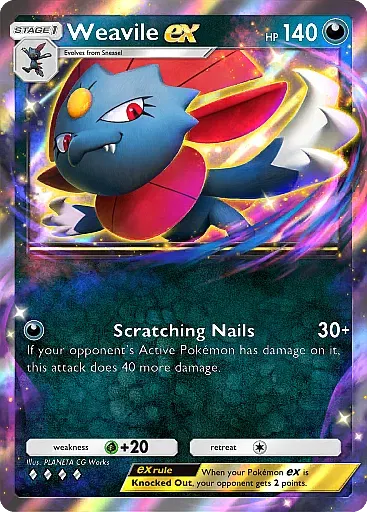
Fast strategies that look to end the game quickly are strong for ranked because of what I like to call Scoop Equity. This just means that it's obvious to tell when we're losing - in which case we can concede once we see the gamestate is unwinnable - and when we're super winning - in which case our opponent concedes for the same reason. In fact, some opponents will concede early into aggressive strategies that start even vaguely well, since it's easy to overestimate how powerful our early starts are. This also ties into rule 1 because fast strategies tend to also be highly consistent. Since our primary attacker is usually going to be a Basic - or a Stage 1 at absolute slowest, such as the Weavile EX deck - being able to attack with something functional and strong happens basically every game. Fast decks are also the hardest punish to an inconsistent deck, since we can easily throttle our opponent before they have time to draw into their lategame win condition if it wasn't in their initial hand.

Let's compare to a powerful deck from the Space-Time Smackdown meta, Darkrai EX. Both the Greninja and Magnezone variants excel at winning games that go long to maximize the value of Darkrai EX's Nightmare Aura. The Greninja variants further accentuate endgame strength by utilizing the combo of Water Shuriken + Cyrus in conjunction with Darkrai EX as a primary attacker to pick and choose targets to convert into points. The problem is it can easily take significantly more time to win a game - and show our opponent we've won and their position is hopeless - to the point where we could easily fit in two or three times as many matches playing the weaker - but still strong - Skarmory aggro deck. It's better to go 4-2 than 2-0 in the same timeframe in the vast majority of ranked ladders, especially counting that we can hit a ranked floor sooner to safeguard our climb.
Rule 3: Play Good Cards, Get Good Results
This rule should be fairly straightforward. It's pretty easy to homebrew a fast, consistent aggressive deck using any number of competitively garbagecan-tier cards, but that's unlikely to get good results. We might have a crazy brew with Houndoom to prevent retreats and a strong Basic to catch people off-guard, but the end of our climb is going to be against people playing strong decks trying to win. Don't bring a knife to a gun fight! Think of this more as a warning to not play the decks you see in weird clickbait videos with the shocked-face "80% winrate?? broken??" thumbnail unless you already know they're good decks.
Strong cards maximize scoop equity in our favor.

The queen of scoop equity is none other than the queen of coin flips, Misty. A good Misty flip can result in a quick concession before we have to worry about the more difficult prospect of actually winning the game. While it might seem like Misty violates Rule 1 (Consistency Is King), it's also the case that it's not hard to find an early turn to play her where a tails flip doesn't lose us the game. It's also the case that strong cards steal games, as we can end up in situations where a topdecked Misty, Cyrus, Sabrina, or any other game-flipping supporter can give us automatic wins where we're otherwise losing.
Generally speaking, any of the decks in "Promising Decks" or higher on the Pokémon Zone Tier List are a good place to start, skewing towards faster decks when possible in keeping with Rule 2 (Quality of Games > Quantity of Games).
What Would I Play Now?
There are three decks I would be skewing towards if Ranked Matches were available in the current Triumphant Light metagame in keeping with my three rules. You can, in fact, probably guess one of them immediately:
It's no accident that I wrote a comprehensive guide to Water 18 Trainers in anticipation of Ranked Mode - I fully expected the first season of ranked to be in the Triumphant Light Metagame! This follows all three of our rules perfectly:
- Our opener isn't just consistent, it's the most consistent possible; we will always get our desired attacker every single game!
- We attack from turn 1 or turn 2 every game no matter what, depending on our starter of choice, and we attack for sizeable early-to-midgame damage to potentially tempo out lategame strategies.
- Misty gives us incredibly high scoop equity and some amount of automatic wins to skip upwards on the ranked ladder.
Water 18 Trainers is a perfect example of a deck that's simply "okay" in 2-of-3 tournament sets but phenomenal at exploiting what you want to accomplish on a ranked ladder. Mars can be a strong "gotcha" against people stockpiling cards in hand, but this can easily be a Giovanni (or Red with the release of Shining Revelry) to push more damage. Let's look at our second choice, which is also dominant in the tournament scene:
While not exactly a fast strategy, we can still excuse being a bit slow due to the sheer power level of an early 130-damage Ultimate Force. Compared to other "slow" strategies, Dialga EX + Arceus EX is also fast enough to secure early concessions if our opponent sees they can't answer a turn 2 Metallic Turbo into a turn 3 Arceus EX. Our consistency is generally good, made better by the high amount of retreat aids to not lose to an early awkward start. And, of course, the card quality is the highest of any deck in the current format. The single biggest point in the deck's favor is in fact our card quality, which makes us dominant into inconsistent weird decks that aren't optimized to beat us.
Our final choice is far and away the most aggressive choice in the current tournament meta, and therefore perfect for our purposes:
Weavile EX has taken off recently to exploit slow starts from the common Stage 2 decks and Dialga+Arceus in the tournament scene, which also fits our purposes here. Since we're shooting to win the best-of-one, this build opts to run Dawn for the occasional automatic wins dealing 90 damage going first, as well as max gust effects and damage potential with Rocky Helmet. We, again, have high scoop equity; it's very easy to tell when we're in a dominant position, we get off to damaging starts every game no matter which Basic we have, we run Cyrus to steal the final points of a match (we are, in fact, maybe the best Cyrus deck), and we also can easily tell when we're outscaled and it's best to go to the next game. This is an example of where I'm willing to go to a Stage 1 evolution if it enables my other rules sufficiently.
Ranked Match is something that much of the playerbase has been clamoring for. I'm hoping for an exciting ladder experience to get more people interested in higher levels of competition.
Until next time, may you automatically win against an opponent who gets stuck on Skull Fossil!