

Loading...
The brewing madness is at its peak when a new expansion drops, and Extradimensional Crisis is no exception. Despite being one of the smallest sets in Pokémon TCG Pocket so far, it offers potential answers to the long-standing Darkrai ex dominance. Let’s take a look at how they performed in the first week of competition.
FrogEX Weekly Cup #18
Player count: 409 players
Prize pool: $50
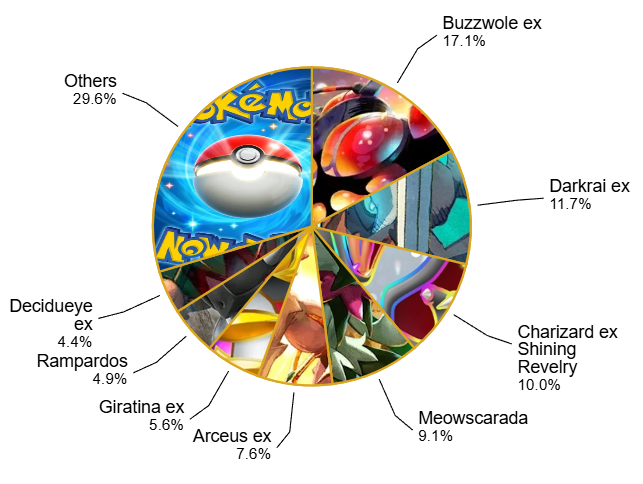
Buzzwole ex quickly stole the spotlight and became the most played deck of the tournament. One reason for its popularity is that the entire Pokémon lineup can be built just by opening only Extradimensional Crisis packs: a rare trait for a meta deck and a great opportunity for players on a budget. As a Grass decks, it also hits the previously top deck of the metagame (Darkrai ex) for weakness. Among the established top decks, Giratina ex surprisingly dropped in usage, with Darkrai ex and Charizard ex still holding grounds.
| Deck | Number in day 2 | Number in top 8 |
|---|---|---|
| Buzzwole ex | 14 | 3 |
| Darkrai ex | 13 | 1 |
| Rampardos | 7 | 1 |
| Charizard ex Shining Revelry | 6 | 1 |
| Giratina ex | 6 | 1 |
| Guzzlord ex | 6 | 0 |
| Arceus ex | 5 | 0 |
| Meowscarada | 5 | 0 |
| Oricorio | 4 | 0 |
| Decidueye ex | 3 | 0 |
| Tapu Koko ex | 3 | 0 |
| Silvally | 2 | 1 |
| Blaine | 1 | 0 |
| Incineroar ex | 1 | 0 |
| Togekiss | 1 | 0 |
And once again, Darkrai ex stood strong against the new wave. That said, the top 77 players brought a fairly diverse spread of archetypes to the table. One deck stood out in conversion rate to top 8: Buzzwole ex.
NestorVL, the most successful pilot, reached top 4 with a rather simple list: 2 Buzzwole ex, 2 Celesteela, and 2 Pheromosa. Celesteela’s Ultra Thrusters can switch one of your Benched Pokémon into the Active spot, provided both are Ultra Beasts. This isn't just helpful for correcting bad openers, it also lets you rotate to the most appropriate Pokémon into the Active slot depending on the situation:
- Pheromosa in the early game and for setting up Cyrus with Jump Blues' splash damage.
- Buzzwole ex when it's charged for a Big Beat.
- Celesteela as a tank while you build up resources.
The biggest highlight is that you can also “cheat” the Big Beat restriction: for instance, switch in a Pheromosa, retreat it manually, and bring Buzzwole ex back to reset its attack clause to use Big Beat two turns in a row!
As a mostly deck, Leaf Cape and Erika give a big boost in survivability to the important Pokémon. Lusamine enables strong comebacks by charging two Energy onto Buzzwole ex, or even Celesteela, if needed. Energies come to the discard pile generally after a knockout –needed to use Lusamine– but you can also feed more Energies in it by retreating.
NestorVL navigated mirror matches and Dark decks (like Guzzlord ex and Darkrai ex) with ease, but hit his worst possible matchup in the semifinals: Charizard ex... with a twist.
Instead of running a 1-of Incineroar ex or 2 Turtonator, Harian included Jigglypuff and Wigglytuff. Wigglytuff isn’t just a decent attacker: it also has Comforting Song, which heals 20 damage from the Active Pokémon. This shuts down Darkrai ex’s Nightmare Aura but also "negates" damage dealt to the Active Pokémon by Pheromosa (though not to the Bench). Additionally, Harian replaced 1 Lillie with Pokémon Center Lady, a less efficient but more versatile option, especially against Poison decks that gained popularity after Nihilego’s release. Since Wigglytuff already heals for 20, the total heal is almost equivalent to Lillie's anyway.
In the top cut, Harian defeated a Darkrai ex and four Buzzwole ex decks, but fell in the finals to TDNmegane's Rampardos/Silvally deck.
Rampardos has a long history of being paired with Stage 1 Pokémon like Lucario or Lycanroc. Extradimensional Crisis introduced another ideal partner: Type: Null, a reasonably bulky Basic that evolves into Silvally, a 110 HP Stage 1 that deals 100 for if you used a Supporter this turn. Thankfully, the deck naturally supports several strong Supporters. Gladion is the most important, able to search for both parts of the evolution line (most importantly Silvally). Iono, Red, Sabrina, and Mars also fit well, helping with consistency, securing knockouts, and disrupting the opponent.
Silvally, while it can't hit for weakness, has several advantages over Lycanroc:
- It deals 100 damage more reliably.
- Its Basic form can attack, and the full line can potentially KO a Basic Pokémon ex in two turns with a lucky coin flip.
- It has a different weakness than both Lycanroc and Rampardos, which matters with the rise of decks.
- It has 10 more HP.
TDNmegane had a fortunate run, facing only one Buzzwole ex in Swiss (and losing), but cruising through matchups that were weak to and unprepared for this deck’s efficiency. The list made quite the impression, and the archetype won several smaller tournaments shortly after release. Two 1-Point attackers able to deal 100 damage and more consistently is a real threat to established decks.
Silvally also proved versatile outside of this archetype. timeforplanb reached top 8 with a deck featuring several Sun & Moon Legendaries.
Here, Silvally is paired with Zeraora, whose Thunderclap Flash ability grants a free Energy at the end of your first turn only. After that, Zeraora hits for a solid 50 damage with just . The second partner is a one-of Oricorio , deadly against decks reliant on Pokémon ex.
This deck is straightforward: fast, efficient attackers that hit hard for just 2 Energy. It includes disruptive Supporters like Giovanni to KO 60HP Basic Pokémon before they evolve, and 2 Pokémon Center Lady to heal weaker hits and chip damage. The highlight is a one-of Dawn: thanks to Zeraora's early Energy, you can power up any Pokémon by turn 3. For Silvally, that means attacking for 100 a turn earlier than usual.
Aggressive and streamlined, the deck struggles against equally fast decks that hit harder. Unsurprisingly, it fell to TDNmegane’s Rampardos Silvally list in a fratricidal top 8 match.
Ursiiday's Pocket Weekly #29
Player count: 922 players
Prize pool: $400 thanks to XPCollect's sponsorship
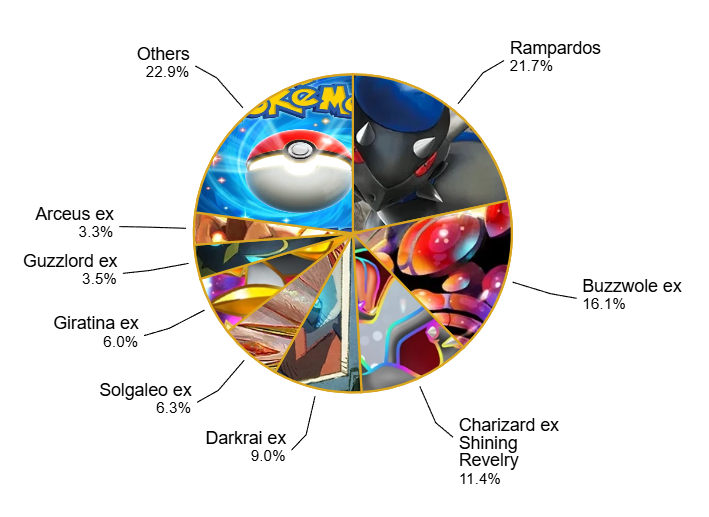
The early success of Rampardos prompted a surge in popularity, making it the most played deck of the tournament. Buzzwole ex and Charizard ex followed, as players seemed to lose some confidence in Darkrai ex.
| Deck | Number in day 2 | Number in top 8 |
|---|---|---|
| Rampardos | 17 | 1 |
| Buzzwole ex | 16 | 3 |
| Solgaleo ex | 9 | 1 |
| Darkrai ex | 7 | 2 |
| Charizard ex Shining Revelry | 4 | 1 |
| Guzzlord ex | 3 | 0 |
| Arceus ex | 3 | 0 |
| Giratina ex | 2 | 0 |
| Garchomp ex | 2 | 0 |
| Tapu Koko ex | 1 | 0 |
Although they were confirmed to be somewhat right, as the share of the Dark deck dropped in top 64, Darkrai ex Giratina still got two spots in the top 8, and even took the trophy home.
The enigmatic Japanese player ・ tore through a stacked bracket with many top tiers archetypes (Buzzwole ex, Rampardos/Silvally, Solgaleo ex/Shiinotic) with a Darkrai ex / Giratina list that ran no new cards from Extradimensional Crisis. One standout detail: they ran three hand disruption cards: 2 Red Card and 1 Mars. These are especially effective against decks with few Basics like Rampardos/Silvally, the event’s most played archetype, and more broadly against every evolution decks. Against Buzzwole ex, which typically runs at least 6 Basics, hand disruption is less effective, but the absence of evolution and the fact that these decks often hold multiple Supporters to react to the board state (e.g., Erika for healing, Cyrus for Bench snipes, Lusamine for Energy acceleration) make hand disruption still impactful in some cases.
In general, going first and dropping the opponent to 3 cards instead of 4 is a nerf whatosever, however subtle it is.
This strategy was a marker of success: three of the top four decks ran two or more hand disruption cards. It’s clearly a solid counter to evolution-heavy strategies like Rampardos/Silvally, but that wasn’t the only evolution deck to make a splash.
redjapan delivered the best run with the Solgaleo ex / Shiinotic deck, reaching top 8. Solgaleo ex was a standout in Celestial Guardians, but it lacked a reliable partner and faded from competitive relevance after a week. Now, with Shiinotic, that might be changing. Shiinotic’s Illuminate ability lets you fetch a random Pokémon from your deck once per turn: a huge boost in consistency. This gives you a realistic shot at getting Solgaleo ex into play by turn 2, via Rare Candy on a turn 1 Cosmog. So why Shiinotic is performing here but not in other evolution decks?
First, even if you open with Morellul Active, you won’t have to pay retreat later thanks to Rising Road, Solgaleo ex’s built-in switching effect. In fact, keeping Morellul and Shiinotic up front shields Cosmog from harm. Second, Solgaleo ex is strong and fast: by turn 4, it can hit for 120 with just 2 Energy, and it has 180 HP with no need for prior setup. Instead of spreading Energy across Skarmory or Excadrill, this variant focuses entirely on turboing into Solgaleo ex and closing games quickly. In a pinch, Shiinotic can also fight against threats like Oricorio .
After starting as the 5th most played deck, Solgaleo ex / Shiinotic rose to become the 3rd most represented in top cut, out of nowhere!
Finally, jeanfelipebn rounded out the top 8 with a modern twist on Darktina, adding a fresh tool from Extradimensional Crisis: Nihilego.
Darktina is most vulnerable in the first six turns, when it needs time to power up Darkrai ex and Giratina ex with Energy before becoming fully operational. Traditional lists lean on healing, HP buffs, or Rocky Helmet damage.
Nihilego adds a new aspect. With More Poison, combined with Poison Barb, Poison now deals 20 damage at the end of each turn, forcing attackers to retreat or suffer high chip damage. This pressure can be enough to handle some Basic Pokémon outright. Plus, Nihilego fits naturally into the deck’s pool.
Where Is the Extradimensional Crisis metagame at?
Extradimensional Crisis has brought far more to the metagame than expected. While Darkrai ex / Giratina remains a top contender, Buzzwole ex has emerged as a true counter, and a strong deck in its own right. Less flashy newcomers like Silvally and Shiinotic, both Stage 1s from the same set, have also pushed archetypes into top-tier status, for a rather diverse early metagame. Rampardos / Silvally initially looked unstoppable, but the community quickly adapted, loading decks with hand disruption to derail its setup.
Charizard ex appears to be a hard counter to Buzzwole ex and also performs well into both Solgaleo ex and Darkrai ex. However, it faces its own struggle: it’s just as vulnerable to hand disruption as the other evolution decks. The coming week will be crucial in assessing whether Stage 2 decks can remain durably competitive or if they’ll be edged out by more consistent, Basic-heavy lists that lean on disruption to make up for lower raw power.
It’s worth noting that the format is finally opening beyond the long-standing Darkrai ex / Giratina duo. The soft counters introduced in the previous set, like Oricorio, showed mixed results. But now, higher overall card quality is pushing new strategies to the forefront.
One big development is free switching, which is becoming a real strategic axis: Solgaleo ex’s Rising Road and Celesteela’s Ultra Thrusters allow decks to rotate Pokémon without spending Energy or slots on one-time retreat options. These reusable effects are tied to relevant Pokémon that double as attackers or tanks. Previously, switching often required dedicated cards or Energy discards. Now, it's becoming embedded in Pokémon. That raises a question: is a TCG staple like Switch on its way to Pocket? If so, it might spell the end for a uniquely Pocket element of gameplay: limited and costly board mobility. The experience may be shifting toward something more streamlined and familiar to veteran TCG players, but at the cost of some of Pocket's original identity.